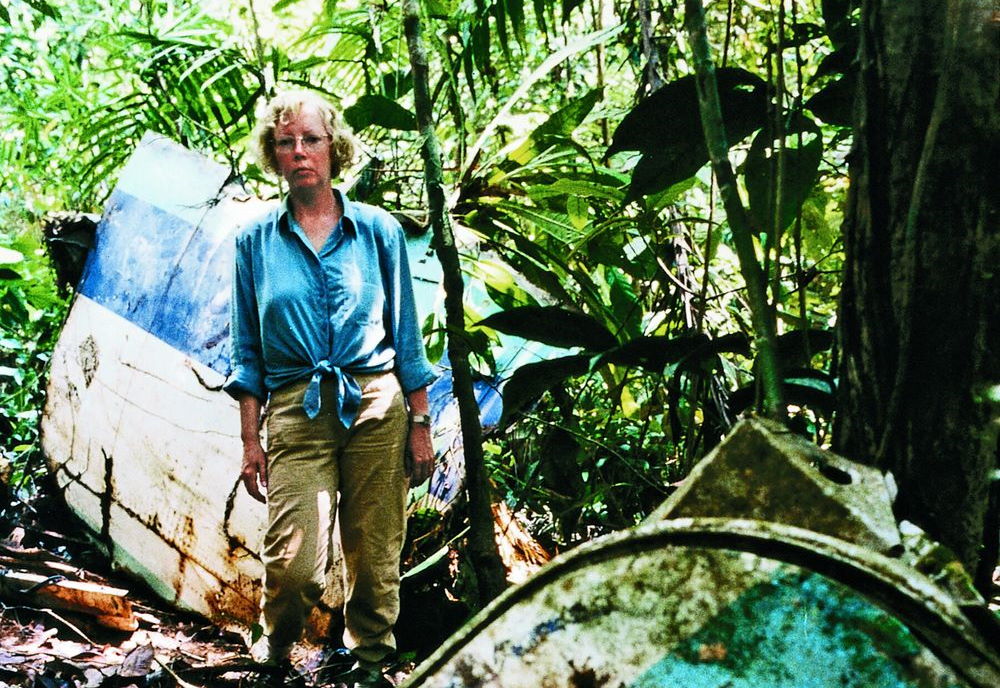
Juliane Koepcke fell two miles out of the sky while strapped to her airplane seat. She crashed straight into the dark Peruvian rainforest, completely alone, and survived. She was only seventeen years old when she unbuckled her seatbelt and walked out of the jungle.
On Christmas Eve in 1971, LANSA Flight 508 was struck by lightning over the Amazon. The plane broke apart in midair. Juliane woke up on the jungle floor with a broken collarbone, a bad cut on her leg, and one swollen eye. By following a small stream of water for eleven terrifying days, she found a tiny cabin and was saved by local fishermen.
The Christmas Eve Flight That Changed Everything
Juliane was traveling with her mother, Maria Koepcke. They were flying from Lima to Pucallpa to visit her father, Hans-Wilhelm Koepcke. He was a famous biologist living at a remote research site deep in the forest. Juliane had just finished high school in Lima. She was excited to spend Christmas with her parents.
The plane was a Lockheed L-188A Electra. About thirty minutes after takeoff, the aircraft flew right into a massive thunderstorm. The sky turned completely dark. The plane bounced wildly up and down. Luggage fell from the overhead bins, and wrapped Christmas presents flew through the cabin. People were crying and screaming.
Then, a bright flash of lightning hit the right engine. Juliane saw a fierce green fire on the wing. Her mother turned to her and spoke her last words: "That is the end, it is all over." Seconds later, the noise was deafening. The plane snapped in two. Juliane was still strapped to her seat row, spinning wildly through the air like a helicopter seed. The wind roared past her ears as she plunged thousands of feet into the thick green jungle below.

Waking Up Alone in the Amazon Jungle
Juliane woke up the next morning, on Christmas Day. She was lying on the wet soil under the thick jungle canopy. Her head was spinning, and her right eye was swollen shut. She was wearing only a simple sleeveless dress and one white sandal. Her eyeglasses were gone, making it hard to see far away.
She checked her body for injury. Her collarbone was broken, and she had a deep gouge in her right calf. Her knee was sprained, but she could still walk. Out of ninety-two people on that plane, Juliane was the only person who lived. It was an amazing human-interest story that people still talk about today.
She searched the area for her mother. She called out into the thick woods, but no answer came. The forest was filled with strange noises, calling birds, and buzzing bugs. All she found was a small bag of candy in the wreckage. That little bag of sweets was the only food she would have for the next eleven days.
Using Survival Secrets Learned From Her Parents
Juliane was not an ordinary teenager. Her parents ran a forest research station called Panguana. She had spent a full year living in the wilderness with them. Her father had taught her simple, life-saving rules for getting lost in the wild. He told her that if you ever get lost in the forest, you must find a trickling stream.
A trickle of water leads to a small brook. A brook flows into a larger stream, and a stream leads to a river. Humans always build their homes near big rivers. If she kept her feet in the moving water, she would eventually find help. That simple rule kept her alive when anyone else might have given up. You can read more about real survival stories of ordinary people who refused to quit when things looked dark.
She found a tiny spring near the crash site and started walking down it. Walking in the water was safer than walking on the forest floor. The water kept her cooler under the boiling sun. It also kept dry snakes away from her feet. But the water brought new problems too. She had to watch out for stingrays in the mud and stingless bees that covered her hair.
Eleven Days of Pain, Hunger, and Insects
Days went by, and the heat was intense. The hot sun burned her bare skin, making her arms and legs blister. She lost her second sandal on the second day, so she had to walk bare-footed. She used her single sandal to test the muddy water in front of her for hidden stingrays. Every step hurt, but she kept moving forward.
By the fourth day, she heard the low rumble of rescue planes flying high above the trees. But the forest canopy was far too thick. The pilots could not see a single person through the tall green leaves. Soon, the engine noises faded away completely. Juliane knew she was totally on her own. No one was coming to save her from the sky.
Her leg wound grew worse each afternoon. Flies laid eggs in the open cut, and tiny maggots began hatching under her skin. The pain was awful, and she could not sleep at night. She stayed awake listening to croaking frogs and the sharp sounds of larger animals sneaking through the dark brush nearby. She used her basic survival skills to keep going day after day.
On the ninth day, her stream finally emptied into a much wider river. The current was very strong, so she floated along the edge. Her skin was soaking wet, cold, and pale. She had no energy left, and her bag of candy was totally empty. She was literally starving to death, but she refused to lie down and stop moving.
How Did Juliane Koepcke Survive the Fall and the Jungle?
It came down to three big things. First, the seat row she was strapped to slowed her fall. The seat acted like a small parachute, and the dense jungle branches broke her impact before she hit the ground. Second, she remembered her father's rules about following water. Third, she had the mental strength to keep moving even when she felt like quitting.
On the tenth afternoon, Juliane spotted a small wooden boat tied up on the riverbank. At first, she thought she was dreaming. She crawled up the muddy bank and saw a narrow dirt path. A few yards up the trail, she found a small open hut with an engine and a tin roof. There was nobody inside, but it felt like a miracle.
Inside the hut, she found a small can of gasoline used for the boat motor. She remembered how her father had treated wounded animals on their farm. She poured the dirty fuel straight onto her infected leg. The gasoline forced thirty-five maggots to crawl out of her skin. The pain was unbearable, but it saved her leg from rot.
Juliane spent that night sleeping on the wooden floor of the hut. She was too weak to walk any further. If no one came, she knew she would die right there in that small wooden shelter.
The Rescue and Her Return to Civilisation
The next morning, three Peruvian woodcutters walked up the path to the hut. They stopped in shock when they saw her lying there. Juliane looked like a ghost. Her skin was dark yellow, her eye was bloody, and her clothes were torn to rags. She spoke to them in clear Spanish: "I am a girl who crashed in the LANSA plane. My name is Juliane."
The men were kind and gentle. They cleaned her wounds, gave her some bread to eat, and put her in their boat. They rowed her down the river for seven long hours to a small lumber town named Tournavista. From there, a local pilot flew her to a hospital in Pucallpa where her father was waiting.
Hans-Wilhelm wept when he hugged his daughter. It was a happy reunion, but it was mixed with terrible grief. A few days later, searchers found the main wreckage of the plane. Juliane's mother had not survived the fall. Juliane was the only person out of all the passengers to come home alive.
Her story made headline news all around the globe. Scientists could hardly believe a teenage girl had survived a fall from two miles up. You can read more about unbelievable survival tales from history on our site.
What Juliane Taught the World
Juliane eventually moved to Germany. She went to college, studied science, and became a successful biologist just like her parents. She returned to the Amazon jungle many times to conduct research on bats and run the nature reserve her father started.
In 2011, she wrote a famous book about her life called *When I Fell From the Sky*. She spent many years wondering why she was the only one who survived that terrible crash. Over time, she learned to view her life as a precious gift that she needed to use well.
Her story shows us how powerful simple knowledge can be when fear sets in. She did not panic, she did not lose her head, and she remembered what her father taught her. Most of all, she kept walking toward the river, one painful step at a time.
Next time you face a situation that feels completely overwhelming, think of Juliane in the dark forest. Keep your feet in the water, follow the small stream, and do not stop moving until you find your way home.
Comments
Post a Comment